Tabla de unión de solo lectura en JPA

Las dos anotaciones de JPA más comunes para mapear relaciones usando una tabla de unión son @JoinTable y la combinación de @ElementCollection y @CollectionTable. En ambos casos, se aplican al lado que posee la relación. Todas las modificaciones a la relación representada por la tabla de unión, por defecto, se sincronizan desde el lado propietario.
Deshabilitar el comportamiento de actualización de la tabla de unión no es tan sencillo. Aunque la anotación @JoinTable contiene atributos @JoinColumn con las propiedades updatable e insertable, estas no afectan a este comportamiento, a diferencia de un join simple. Veámoslo con un ejemplo:
import lombok.Getter;
import lombok.Setter;
import lombok.ToString;

import javax.persistence.CollectionTable;
import javax.persistence.Column;
import javax.persistence.ElementCollection;
import javax.persistence.Entity;
import javax.persistence.GeneratedValue;
import javax.persistence.GenerationType;
import javax.persistence.Id;
import javax.persistence.JoinColumn;
import javax.persistence.JoinTable;
import javax.persistence.ManyToMany;
import javax.persistence.Table;
import java.util.ArrayList;
import java.util.List;

@Getter
@Setter
@Entity
@Table(name="users")
@ToString(exclude = "id", callSuper = true)
public class User extends Person {

    @Id
    @GeneratedValue(strategy = GenerationType.IDENTITY)
    private Long id;
    private String name;

    @ManyToMany
    @JoinTable(name = "mentored_users",
            joinColumns = {@JoinColumn(name = "mentee_user_id",
                    insertable = false, updatable = false)},
            inverseJoinColumns = {@JoinColumn(name = "mentor_user_id",
                    insertable = false, updatable = false)}
    )
    private List<User> mentors = new ArrayList<>();

    @ElementCollection
    @CollectionTable(name = "mentored_users",
            joinColumns = {@JoinColumn(name = "mentee_user_id")}
    )
    @Column(name = "mentor_user_id")
    private List<Long> mentorIds = new ArrayList<>();


    public void addMentor(User mentor) {
        mentors.add(mentor);
        mentorIds.add(mentor.getId());
    }

}
En el ejemplo anterior, tenemos una entidad usuario sencilla con una relación muchos a muchos en forma de vínculo mentor (usuario) — aprendiz (usuario). Esta relación se mapea de dos formas usando @JoinTable (lista de entidades) y @ElementCollection (lista de IDs de entidad). El cascade está desactivado por defecto. Ahora intentemos persistir dos objetos y añadir una relación entre ellos:
import org.junit.jupiter.api.BeforeEach;
import org.junit.jupiter.api.Test;
import org.springframework.boot.test.context.SpringBootTest;

import javax.persistence.EntityManager;
import javax.persistence.EntityManagerFactory;
import javax.persistence.PersistenceUnit;
import javax.persistence.Query;
import java.math.BigInteger;
import java.util.ArrayList;
import java.util.List;
import java.util.Map;

import static org.hamcrest.MatcherAssert.*;
import static org.hamcrest.Matchers.*;

@SpringBootTest
public class ReadOnlyCollectionTest {

    @PersistenceUnit
    EntityManagerFactory entityManagerFactory;
    EntityManager entityManager;

    @BeforeEach
    public void setUp() {
        entityManager = entityManagerFactory.createEntityManager();
    }

    @Test
    public void testReadOnlyJoinTablePersist() {
        User mentor = new User();
        mentor.setName("ALICE");

        User mentee = new User();
        mentee.setName("BOB");

        entityManager.getTransaction().begin();
        entityManager.persist(mentor);
        mentee.addMentor(mentor);
        entityManager.persist(mentee);
        entityManager.getTransaction().commit();

        List<Map<String, Object>> mentors = getMentorJoinTable();
        assertThat(mentors, hasSize(1));
        assertThat(mentors.get(0), hasEntry(
                equalToIgnoringCase("mentor_user_id"),
                anyOf(// Long o BigInteger según el dialecto
                        equalToObject(mentor.getId()),
                        equalTo(BigInteger.valueOf(mentor.getId()))
                )
        ));
        assertThat(mentors.get(0), hasEntry(
                equalToIgnoringCase("mentee_user_id"),
                anyOf(
                        equalToObject(mentee.getId()),
                        equalTo(BigInteger.valueOf(mentee.getId()))
                )
        ));
    }

    // Hibernate
    private List<Map<String, Object>> getMentorJoinTable() {
        Query nativeQuery = entityManager.createNativeQuery("SELECT * FROM mentored_users");
        org.hibernate.query.Query<?> hibernateQuery = (org.hibernate.query.Query<?>) nativeQuery;
        hibernateQuery.setResultTransformer(org.hibernate.transform.AliasToEntityMapResultTransformer.INSTANCE);
        //noinspection unchecked
        return nativeQuery.getResultList();
    }

    // EclipeLink
    private List<Map<String, Object>> getMentorJoinTable() {
        //noinspection unchecked
        return entityManager.createNativeQuery("SELECT * FROM mentored_users")
                .setHint(
                        org.eclipse.persistence.config.QueryHints.RESULT_TYPE,
                        org.eclipse.persistence.config.ResultType.Map
                )
                .getResultList();
    }
}
Para ambos, Hibernate y EclipseLink, EntityManager construye y envía dos consultas insert para añadir una relación en la tabla de unión. Se lanza una RollbackException.
Registros de Hibernate:
2022-02-20 14:39:40.533 DEBUG 2760 --- [main] org.hibernate.SQL                        :

values
    identity_val_local()
Hibernate:

values
    identity_val_local()
2022-02-20 14:39:40.554 DEBUG 2760 --- [main] org.hibernate.SQL                        :
    /* insert collection
        row User.mentorIds */ insert
        into
            mentored_users
            (mentee_user_id, mentor_user_id)
        values
            (?, ?)
Hibernate:
    /* insert collection
        row User.mentorIds */ insert
        into
            mentored_users
            (mentee_user_id, mentor_user_id)
        values
            (?, ?)
2022-02-20 14:39:40.558 TRACE 2760 --- [main] o.h.type.descriptor.sql.BasicBinder      : binding parameter [1] as [BIGINT] - [6]
2022-02-20 14:39:40.558 TRACE 2760 --- [main] o.h.type.descriptor.sql.BasicBinder      : binding parameter [2] as [BIGINT] - [5]
2022-02-20 14:39:40.559 DEBUG 2760 --- [main] org.hibernate.SQL                        :
    /* insert collection
        row User.mentors */ insert
        into
            mentored_users
            (mentee_user_id, mentor_user_id)
        values
            (?, ?)
Hibernate:
    /* insert collection
        row User.mentors */ insert
        into
            mentored_users
            (mentee_user_id, mentor_user_id)
        values
            (?, ?)
2022-02-20 14:39:40.562 TRACE 2760 --- [main] o.h.type.descriptor.sql.BasicBinder      : binding parameter [1] as [BIGINT] - [6]
2022-02-20 14:39:40.562 TRACE 2760 --- [main] o.h.type.descriptor.sql.BasicBinder      : binding parameter [2] as [BIGINT] - [5]
2022-02-20 14:39:40.570  WARN 2760 --- [main] o.h.engine.jdbc.spi.SqlExceptionHelper   : SQL Error: 20000, SQLState: 23505
2022-02-20 14:39:40.570 ERROR 2760 --- [main] o.h.engine.jdbc.spi.SqlExceptionHelper   : The statement was aborted because it would have caused a duplicate key value in a unique or primary key constraint or unique index identified by 'SQL220220143939760' defined on 'MENTORED_USERS'.
Registros de EclipseLink:
[EL Fine]: sql: 2022-02-20 15:19:14.204--ClientSession(1679352734)--Connection(488422671)--Thread(Thread[main,5,main])--INSERT INTO mentored_users (mentee_user_id, mentor_user_id) VALUES (?, ?)
    bind => [6, 5]
[EL Finest]: query: 2022-02-20 15:19:14.21--ClientSession(1679352734)--Thread(Thread[main,5,main])--Execute query DataModifyQuery(name="mentors" )
[EL Fine]: sql: 2022-02-20 15:19:14.21--ClientSession(1679352734)--Connection(488422671)--Thread(Thread[main,5,main])--INSERT INTO mentored_users (mentor_user_id, mentee_user_id) VALUES (?, ?)
    bind => [5, 6]
[EL Fine]: sql: 2022-02-20 15:19:14.224--ClientSession(1679352734)--Thread(Thread[main,5,main])--VALUES(1)
[EL Warning]: 2022-02-20 15:19:14.232--ClientSession(1679352734)--Thread(Thread[main,5,main])--Local Exception Stack:
Exception [EclipseLink-4002] (Eclipse Persistence Services - 2.7.10.v20211216-fe64cd39c3): org.eclipse.persistence.exceptions.DatabaseException
Internal Exception: org.apache.derby.shared.common.error.DerbySQLIntegrityConstraintViolationException: The statement was aborted because it would have caused a duplicate key value in a unique or primary key constraint or unique index identified by 'SQL220220151913200' defined on 'MENTORED_USERS'.
Error Code: 20000
Call: INSERT INTO mentored_users (mentor_user_id, mentee_user_id) VALUES (?, ?)
    bind => [5, 6]
Tabla de unión de solo lectura
El ejemplo anterior no es del todo correcto desde el punto de vista de JPA. Sin embargo, las implementaciones de JPA nos permiten modificar la relación de una forma que se adapte a nuestras necesidades.
Hibernate
Las interfaces org.hibernate.persister.entity.EntityPersister y org.hibernate.persister.collection.CollectionPersister junto con la anotación org.hibernate.annotations.Persister permiten definir una lógica de mapeo personalizada para un campo específico. Simplemente extiende la clase BasicCollectionPersister estableciendo el flag inverse en el constructor. Así, se omite el guardado, actualización y borrado de filas en la tabla de unión como si la relación fuera propiedad del otro lado.
import org.hibernate.MappingException;
import org.hibernate.cache.CacheException;
import org.hibernate.cache.spi.access.CollectionDataAccess;
import org.hibernate.mapping.Collection;
import org.hibernate.persister.collection.BasicCollectionPersister;
import org.hibernate.persister.spi.PersisterCreationContext;

public class ReadOnlyCollectionPersister extends BasicCollectionPersister {
    private static Collection asInverse(Collection collection) {
        collection.setInverse(true);
        return collection;
    }

    public ReadOnlyCollectionPersister(
            Collection collectionBinding,
            CollectionDataAccess cacheAccessStrategy,
            PersisterCreationContext creationContext) throws MappingException,
            CacheException {
        super(asInverse(collectionBinding), cacheAccessStrategy, creationContext);
    }
}
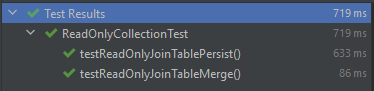
Ahora añade la anotación @Persister apuntando al contrato de mapeo, y la prueba pasará:
    //...
    @ManyToMany
    @JoinTable(name = "mentored_users",
            joinColumns = {@JoinColumn(name = "mentee_user_id")},
            inverseJoinColumns = {@JoinColumn(name = "mentor_user_id")}
    )
    @Persister(impl = ReadOnlyCollectionPersister.class)
    private List<User> mentors = new ArrayList<>();
    //...
Hibernate también proporciona la anotación org.hibernate.annotations.Immutable. Sin embargo, no encaja del todo con nuestra solución. Básicamente, impide eliminar y añadir elementos a la colección de un objeto gestionado lanzando una excepción. Además de BasicCollectionPersister, puedes extender la clase OneToManyPersister si usas la anotación @OneToMany.
EclipseLink
En el caso de EclipseLink, puedes modificar la información de mapeo usando la anotación a nivel de tipo org.eclipse.persistence.annotations.Customizer. Esta anotación es el punto de entrada para la implementación de la interfaz org.eclipse.persistence.config.DescriptorCustomizer. Para obtener un resultado similar en la gestión de la tabla intermedia, podemos usar la funcionalidad de solo lectura. Aunque no puedes añadir la anotación @ReadOnly en un campo, puedes poner la relación en modo esperado durante la configuración del descriptor.
import org.eclipse.persistence.config.DescriptorCustomizer;
import org.eclipse.persistence.descriptors.ClassDescriptor;

public class UserDescriptorCustomizer implements DescriptorCustomizer {
    @Override
    public void customize(ClassDescriptor descriptor) {
        descriptor.getMappingForAttributeName("mentors").setIsReadOnly(true);
    }
}
Puedes aplicar el customizer en la clase de entidad:
//...
@Customizer(UserDescriptorCustomizer.class)
public class User extends Person { /*...*/ }