SQLITE_DEFAULT_MEMSTATUS - the SQLite mutex you didn't know rusqlite was holding

If you embed SQLite in a Rust service via rusqlite v0.39.0 with the bundled feature, libsqlite3-sys compiles the embedded sqlite3.c from source with SQLITE_DEFAULT_MEMSTATUS=1 in effect - rusqlite passes a list of -DSQLITE_* flags to the C build but never overrides this one, so SQLite's upstream default of 1 stays.
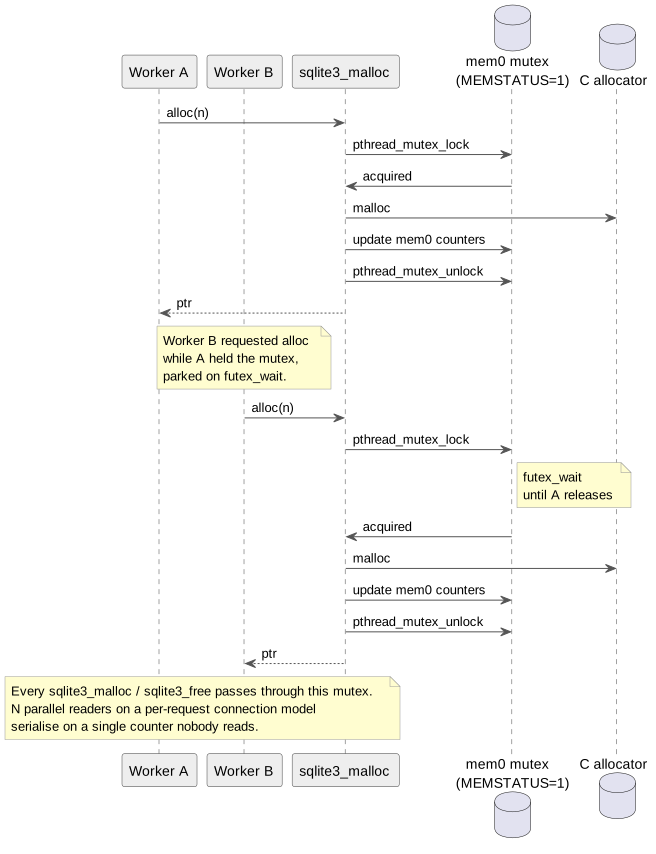
That puts every sqlite3_malloc and sqlite3_free behind a single process-wide mutex.
On one thread you never feel it. With parallel readers and a per-request connection model, it can cap throughput hard. The fix is one build-time env var.
What the flag actually does
SQLite tracks process-wide memory accounting (sqlite3_memory_used(), sqlite3_status()). To make those numbers consistent across threads, every allocation and free updates a counter under a mutex. The SQLite docs list SQLITE_DEFAULT_MEMSTATUS=0 among the recommended-for-speed compile options:
This setting causes the sqlite3_status() interfaces that track memory usage to be disabled. This helps the sqlite3_malloc() routines run much faster, and since SQLite uses sqlite3_malloc() internally, this helps to make the entire library faster.
The docs sell the speedup; the mechanism behind it is dropping a process-global mutex from every alloc and free - which Keith Medcalf stated bluntly on the SQLite forum: enabling MEMSTATUS has "the side effect of wrapping the memory allocators in a mutex (ie, only one thread of execution at a time may access the memory allocator)". Setting SQLITE_DEFAULT_MEMSTATUS=0 at compile time disables the counter and the mutex. The C-level malloc/free calls go straight through.
Who builds with =0, and who doesn't
The interesting asymmetry is between drivers. SQLite is the same C source tree, but each ecosystem ships its own build:
| Project | SQLITE_DEFAULT_MEMSTATUS | Set where |
|---|---|---|
| rusqlite (bundled) | =1 (upstream default) | not overridden |
| sqlite-jdbc | =0 | Makefile.common |
| node:sqlite (Node) | =0 | PR #56541 (Jan 2025) |
| CPython sqlite3 | =0 | setup_helpers.py |
Three of the four mainstream embedded-SQLite stories explicitly disable the mutex. The Rust one doesn't.
When the default actually bites
Three conditions together:
- Multiple threads inside SQLite C at the same time. A web service with a worker pool that calls SQLite under load. Single-threaded code never sees the mutex.
- A per-request connection lifecycle, or any pattern with high allocation churn - parsing, opening, closing. Each
sqlite3_openparsessqlite_master, allocates schema structures, opens a B-tree. Each close tears it down. Many small allocations per request -> many mutex acquires per request. - Enough cores for the mutex to actually contend. On a 1-2 vCPU container at low concurrency, the difference is measurement noise.
I hit it on a 16-thread Ryzen with a Rust + axum service that opened a fresh Connection per request. At 50 concurrent users on a small-payload single-row endpoint, throughput was 5,622 req/s and perf record -g showed ~18% of CPU in __lll_lock_wake/wait rooted at sqlite3_malloc. With the flag flipped: 30,737 req/s and the futex slice was gone.
How to flip it from your Rust app
You depend on rusqlite the usual way - bundled feature on, so cargo will compile the embedded SQLite for you:
# Cargo.toml
[dependencies]
rusqlite = { version = "0.39", features = ["bundled"] }
There is no Cargo.toml feature that toggles SQLITE_DEFAULT_MEMSTATUS. The supported escape hatch, documented in the rusqlite README, is a LIBSQLITE3_FLAGS environment variable that libsqlite3-sys reads when it compiles the bundled SQLite. The cleanest place to pin it for your project is a checked-in .cargo/config.toml, which sets env vars for every cargo build / cargo test / cargo run in the workspace:
# .cargo/config.toml
[env]
LIBSQLITE3_FLAGS = "SQLITE_DEFAULT_MEMSTATUS=0 SQLITE_DISABLE_PAGECACHE_OVERFLOW_STATS"
Commit that file alongside Cargo.toml. Every contributor and every CI runner that builds your app inherits the flag with zero extra setup; cargo emits cargo:rerun-if-env-changed=LIBSQLITE3_FLAGS, so editing the value rebuilds libsqlite3-sys automatically (no cargo clean needed).
Ad-hoc invocations work the same way - export and build:
export LIBSQLITE3_FLAGS="SQLITE_DEFAULT_MEMSTATUS=0 SQLITE_DISABLE_PAGECACHE_OVERFLOW_STATS"
cargo build --release
Same shape if you pin it in a Nix devshell (flake.nix devShells.default), a GitHub Actions env: block, or a Docker ENV line. The format the README guarantees: whitespace-separated tokens, each one of SQLITE_XYZ=value, -DSQLITE_XYZ, or -USQLITE_XYZ.
Verify the flag took effect by querying compile options at runtime:
let flags: Vec<String> = conn
    .prepare("SELECT * FROM pragma_compile_options();")?
    .query_map([], |r| r.get(0))?
    .collect::<Result<_, _>>()?;
Counter-intuitively, a default rusqlite build does NOT list DEFAULT_MEMSTATUS at all - SQLite's pragma_compile_options() only emits options whose value differs from the upstream default. After you flip to =0, the entry DEFAULT_MEMSTATUS=0 appears in the output (along with anything else you set via LIBSQLITE3_FLAGS).
Trade-offs
Setting =0 makes sqlite3_memory_used() and sqlite3_status() return zero. If your code depends on those (very few applications do; it's an introspection API for embedded debugging), this flag breaks them.
There is no correctness impact. Allocations still happen, frees still happen; only the accounting counter goes away. The flag is what sqlite-jdbc, Node, and CPython's stdlib sqlite3 already ship with - so by flipping it you converge on the more common production setting, not diverge from it.
See the SQLite forum thread on SQLITE_DEFAULT_MEMSTATUS for the upstream discussion.